
Why Durability Matters: The Science Behind Rudra Paint Products

Across factories, steel structures, storage assets, workshops, and infrastructure projects, the conversation around industrial coatings gujarat should begin with one question: how long will the surface keep performing under real stress? In industrial settings, paint is not just a finishing touch. It is a protective barrier expected to resist moisture, chemicals, abrasion, heat, sunlight, and daily wear. When that barrier breaks down too soon, the consequences often extend far beyond appearance. Premature failure can expose metal to corrosion, weaken maintenance planning, interrupt operations, and shorten asset life. That is why durability matters so deeply, and why the science behind products from RUDRA PAINT deserves careful attention.
Why industrial coatings gujarat demand true durability
Industrial environments in Gujarat can be demanding. Surfaces may face humidity, salt-laden air in coastal areas, temperature swings, mechanical impact, process chemicals, dust, and constant cleaning. Under those conditions, a coating has to do far more than look neat on the day it is applied. It must hold its film integrity, maintain adhesion, and protect the substrate over time.
For decision-makers comparing industrial coatings gujarat, durability is the line between planned maintenance and recurring failure. A durable coating system reduces the frequency of repair cycles, helps preserve the condition of valuable equipment, and supports more predictable operating costs. In practical terms, durability is about retaining performance under exposure, not simply achieving initial gloss or color.
That distinction matters because industrial coating failure usually happens in identifiable ways: blistering from trapped moisture, peeling from poor adhesion, chalking from UV exposure, rust creep from damaged edges, or softening under chemical contact. Each failure mode points to a gap in formulation, surface preparation, application, or system selection. Understanding those causes is the first step toward choosing better products and applying them more intelligently.
The science behind a durable coating system
A high-performing industrial coating behaves like an engineered film. Its durability comes from how well its chemistry, film build, and curing profile suit the job. Even before application technique enters the picture, the coating itself needs the right balance of resin, pigment, additives, and solvent or carrier system.
Adhesion: The coating must bond strongly to the substrate, whether that substrate is steel, concrete, machinery, or fabricated metal. Without strong adhesion, even a hard top layer can separate under impact, thermal movement, or moisture intrusion.Barrier protection: A durable film slows the entry of water, oxygen, salts, and contaminants. This is essential for corrosion control because rust begins when the substrate is exposed long enough to react with its environment.Chemical and mechanical resistance: Industrial surfaces are often wiped, washed, walked on, loaded, or exposed to fumes and spills. The coating must resist softening, staining, scratching, and wear while maintaining its structure.Proper curing: A coating is only as good as its cure. If the film does not reach the right hardness or cross-linking level, its long-term resistance may be compromised even if it looked acceptable immediately after application.
This is why durability cannot be judged by one property alone. Hardness without flexibility can lead to cracking. Gloss without chemical resistance offers little protection. Thickness without proper curing may create its own problems. Good product design is about balance. When industrial buyers evaluate options from RUDRA PAINT, the most useful question is not whether a coating looks premium, but whether the coating system is appropriate for the service conditions it will actually face.
Surface preparation and environment: the factors that decide real-world performance
Even a strong formulation can fail if the surface below it is not properly prepared. Industrial coatings do not perform in isolation; they perform as part of a complete system that starts with the substrate. Dirt, mill scale, moisture, grease, loose rust, and old unstable films can all interfere with adhesion and shorten service life.
In many industrial jobs, surface preparation is where durability is won or lost. Clean, sound, and properly profiled surfaces give coatings a mechanical and chemical foothold. By contrast, shortcuts at this stage may only delay failure, not prevent it.
Steel surfaces often need thorough cleaning and rust removal before priming.Concrete surfaces may require attention to laitance, moisture, porosity, and surface soundness.Previously painted substrates need compatibility checks so new layers do not lift, wrinkle, or delaminate.Application conditions such as temperature, humidity, and recoat intervals affect cure and final film properties.
Environmental exposure also determines what durability really means. A plant handling chemicals needs a different kind of protection from a structure exposed mainly to sunlight and rain. Equipment near furnaces or hot process lines has different demands from interior metalwork in a dry production space. The strongest coating choice is rarely the most universal one; it is the one matched most closely to the risk profile.
Choosing the right coating family for the job
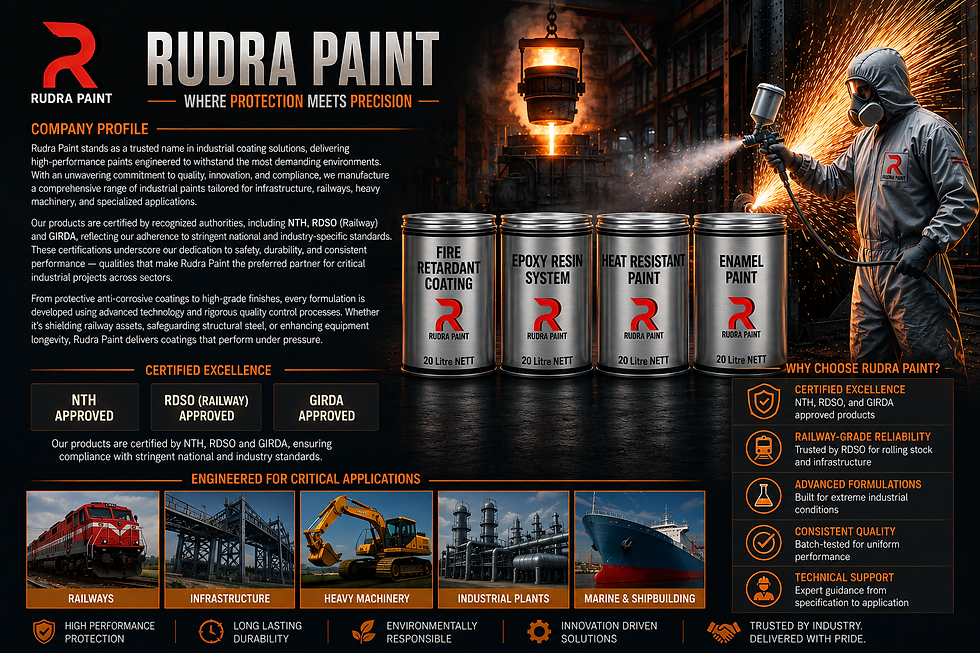
Durability improves when coating type and service condition are aligned. That is why industrial buyers often work through performance needs first and product family second. Common categories such as epoxy paint, synthetic enamel paint, heat resistant paint, fire retardant paint, and other specialized coatings each serve different roles.
Coating family | Where it is often used | Primary durability strength | Key consideration |
Epoxy paint | Steel structures, machinery, shop floors, process areas | Strong adhesion, chemical resistance, tough protective film | Needs correct surface preparation and curing conditions |
Synthetic enamel paint | General metal surfaces, equipment, maintenance finishes | Good finish quality and practical day-to-day protection | Best selected where exposure is moderate rather than extreme |
Heat resistant paint | Hot surfaces, ducts, exhaust-related equipment, process areas | Designed to withstand elevated temperatures better than standard coatings | Must match the actual temperature range in service |
Fire retardant paint | Applications where delayed flame spread or fire performance is a key concern | Adds a protective function beyond conventional decorative coating | Should be specified with a clear understanding of compliance needs |
Specialized paint | Unique industrial conditions such as chemical exposure or special substrates | Targeted performance for specific operating demands | Selection should be based on a clear exposure assessment |
This is where a manufacturer such as RUDRA PAINT becomes relevant in a practical way. Buyers are not only choosing a can of paint; they are choosing a protection strategy. The better approach is to identify the substrate, expected life, exposure conditions, maintenance schedule, and application method before selecting the system. That process usually leads to better durability than choosing purely by price or surface appearance.
What durability should mean when evaluating RUDRA PAINT products
If durability is the goal, product evaluation should be disciplined. A sensible review goes beyond shade cards and basic finish preferences. It should focus on fit for purpose, preparation demands, and the likely life of the complete system.
Define the exposure: Is the surface facing water, chemical splashes, high heat, UV, abrasion, or a mix of these?Identify the substrate: Steel, concrete, fabricated equipment, and previously painted surfaces all behave differently.Confirm the coating system: Primer, intermediate layers, and topcoat should work together rather than as isolated products.Review application realities: Shop application and site application may impose different constraints on drying, curing, and recoat timing.Plan for maintenance: The best durable finish is one that supports inspection, touch-up, and lifecycle management without constant rework.
That is the mindset buyers should bring when reviewing products from RUDRA PAINT. Durability is not accidental. It comes from chemistry, preparation, correct specification, and disciplined application. In a region with demanding industrial conditions, that combination matters more than ever.
In the end, industrial coatings gujarat should be judged by the protection they deliver over time, not by how quickly they are applied or how impressive they appear on day one. Long-lasting performance protects assets, reduces disruption, and supports more responsible maintenance decisions. That is the real science behind durability, and it is the standard that should shape every serious coating choice.
Published with Rabbit SEO
Comments